Pretend play turns ordinary objects into places, people, problems, and possibilities. A cardboard shop can become a busy market. A toy doctor kit can create a worried patient, a caring nurse, and a difficult decision. These small scenes give children practical reasons to describe events, connect ideas, and keep a story moving.
So, how can pretend play toys enhance storytelling skills? They provide visible prompts that make abstract storytelling easier to understand. A costume suggests character. A puppet invites dialogue. A kitchen set introduces setting, sequence, and everyday conflict. Research on imaginative play also links role-play with language growth, social understanding, and flexible thinking. Dr. Dorothy G. Singer, a respected researcher in child development and pretend play, stated, “Pretend play is a way for children to learn about the world.” Her observation helps explain why children often tell richer stories when their hands are actively involved.
This guide examines ten pretend play toy types that can support storytelling development, from dolls and puppets to construction sets and miniature worlds. Each category highlights the storytelling skills it may encourage, including character creation, sensory description, cause and effect, and emotional expression. The results are not automatic. A toy alone cannot make every child a confident storyteller. Adult questions, patient listening, and repeated play matter too. Some children may prefer silent building before speaking. That is perfectly acceptable. Growth can look messy. A child may change the plot halfway through, forget details, or repeat one dramatic scene for days. Those moments still offer valuable practice.
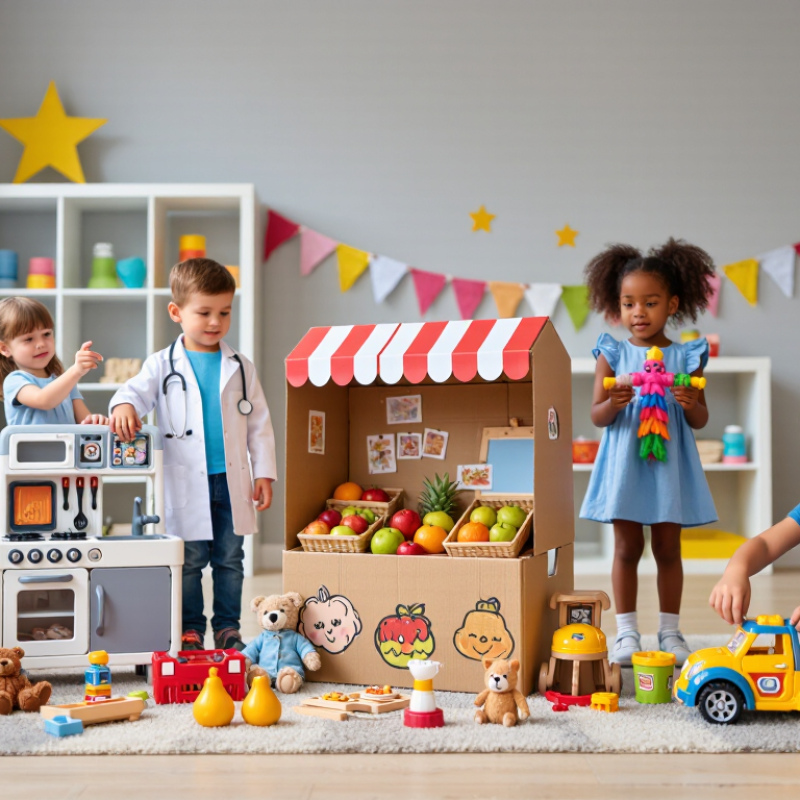
Pretend play means children use objects, roles, and imagined situations to represent real or invented experiences. A 2024 global play survey reported that nearly 9 in 10 parents value pretend play. That matters. Parents often notice children rehearsing conversations, solving conflicts, and changing endings during play.
Ten toy types can support this storytelling practice: dolls and figures, play kitchens, dress-up clothes, tool sets, doctor kits, puppets, toy vehicles, animal figures, building blocks, and playhouses. Each type offers a different narrative doorway. A kitchen can become a busy restaurant. A cardboard vehicle can travel through a storm. Blocks may become a hospital, castle, or space station.
The American Academy of Pediatrics links play with language, executive function, and social-emotional growth. UNICEF’s learning-through-play guidance also emphasizes active, meaningful, and socially interactive experiences. These findings support open-ended toys more than toys with one fixed script. Adults can add useful prompts, such as, “What happens next?” or “Why is the character worried?” Keep the prompt brief. Children need room to lead.
A practical warning remains. More toys do not guarantee better stories. Too many choices can interrupt attention. My own observation is less tidy: some children ignore a carefully chosen toy and prefer a box. That is not failure. It may show that imagination needs space, not constant direction.
Pretend play gives children opportunities to create characters, settings, problems, actions, and endings. The age ranges below are general developmental guides rather than strict limits; children can use many of these toy types with adult support at different ages.
| No. | Pretend Play Toy Type | Typical Starting Age | Story Elements It Encourages | Primary Storytelling Skills | Example Story Prompt |
|---|---|---|---|---|---|
| 1 | Doll and Figure Sets | 2–3 years | Characters, relationships, emotions, and everyday events | Dialogue, perspective-taking, sequencing, and emotional vocabulary | “The character feels worried. What happened, and who can help?” |
| 2 | Pretend Kitchen and Food Sets | 2–3 years | Routines, goals, actions, and cause-and-effect events | Action verbs, functional language, ordering events, and conversation | “A special guest is arriving. What will the characters prepare first?” |
| 3 | Doctor and Caregiver Kits | 3–4 years | Problems, responses, roles, and resolutions | Problem-solving language, questioning, empathy, and narrative structure | “The patient has a problem. How will the caregiver find out what is wrong?” |
| 4 | Vehicles and Road-Play Sets | 2–4 years | Journeys, destinations, obstacles, and changing settings | Spatial words, sequencing, prediction, and descriptive language | “The travelers need to reach a new place, but the road is blocked. What happens next?” |
| 5 | Animal Figures and Habitats | 2–4 years | Characters, habitats, survival challenges, and adventures | World-building, classification vocabulary, cause and effect, and imagination | “An animal has wandered away from its habitat. How will it find its way home?” |
| 6 | Building Blocks and Construction Sets | 3–5 years | Settings, structures, planning, failure, and revision | Planning language, spatial description, flexible thinking, and persistence | “The community needs a safe place before sunset. What should be built first?” |
| 7 | Puppets and Hand Characters | 3–5 years | Dialogue, conflict, humor, character motives, and endings | Oral fluency, turn-taking, voice expression, and point of view | “Two characters want the same thing. How can they solve the disagreement?” |
| 8 | Dress-Up and Role-Play Accessories | 3–5 years | Identity, roles, settings, missions, and social situations | Character development, expressive language, inference, and social communication | “You are entering a new place in costume. What is your mission there?” |
| 9 | Puppet Theaters and Story Props | 4–6 years | Beginning, middle, ending, conflict, and resolution | Narrative planning, retelling, sequencing, and audience awareness | “A surprise changes the plan in the middle of the show. How does the story end?” |
| 10 | Miniature Worlds and Open-Ended Loose Parts | 4–7 years | Complex settings, multiple characters, parallel events, and imaginative rules | World-building, sustained storytelling, collaboration, and creative problem-solving | “Several characters live in this world. What rule keeps the community working together?” |
Tip: Ask open-ended questions such as “What happened next?”, “How does the character feel?”, and “What could solve the problem?” to extend the story without taking control of the play.
Dolls, costumes, puppets, vehicles, blocks, and play kitchens create flexible stories. Each toy offers roles, settings, props, or movement. A cardboard box can work surprisingly well.
Blocks can become houses, bridges, towers, or damaged roads. A scarf might become a river, cape, or blanket. Small changes keep familiar stories moving.
Use manageable problems, such as a lost animal or broken bridge. A missing lunch can encourage planning and empathy. Avoid frightening or overwhelming situations.
Ask, “What changed?” or “Who needs help?” Let children choose the characters’ words and actions. Too many adult instructions weaken ownership.
Match the toy to the child’s abilities, coordination, and supervision needs. Younger children usually need larger parts and simpler accessories. Age labels help, but they are not perfect.
Inspect loose buttons, long cords, sharp edges, and accessible batteries. Keep tiny accessories away from children who mouth objects. Small parts matter. Check cracked wheels and damaged surfaces regularly.
Toys with movable parts often support longer narratives. Dollhouses, costumes, kitchens, puppets, and construction sets offer many changes. Popularity alone does not prove storytelling value.
Observe repeated characters, settings, and problems for one week. Notice whether the child adds new choices or repeats one routine. I may overestimate a toy’s educational value. Observation matters more than packaging claims.
Pretend play toys turn everyday play into a flexible storytelling workshop. This article explores how can pretend play toys enhance storytelling skills by grouping ten toy types into roles, settings, props, and story conflicts. From figures and costumes to miniature homes, vehicles, construction sets, and problem-solving kits, each category encourages children to create characters, sequence events, describe actions, and develop imaginative solutions. Open-ended toys are especially valuable because they allow children to change the plot, negotiate roles, and build stories together.
The guide also connects each toy type with language growth, including vocabulary, conversation, emotional expression, and narrative structure. It considers age suitability, durability, supervision, and general toy-safety principles when comparing options for different developmental stages. Finally, the ranking focuses on storytelling potential, giving priority to toys that support flexible scenarios, repeated play, social cooperation, and increasingly complex plots. Parents and educators can use these ideas to choose play materials that make storytelling natural, engaging, and developmentally appropriate.

 Angeles Toys
