Pretend play turns a shared room into a kitchen, clinic, market, or rescue station. Children negotiate roles, exchange materials, and solve small problems together. These moments reveal why pretend play matters beyond entertainment. The best toys create reasons to communicate, wait, listen, and adjust.
This guide explores China’s top 10 pretend play toy types that encourage teamwork in practical ways. The selection includes role-play kitchens, doctor kits, construction sets, market stalls, rescue toys, puppet theaters, dress-up sets, transportation toys, community-helper kits, and pretend classrooms. These categories reflect common playroom observations and early-childhood teaching practices. Each type offers a different social challenge. A market stall may require one child to sell while another counts pretend money. A construction set can turn scattered blocks into a shared bridge. Sometimes, however, children compete for the most attractive role. That weakness deserves attention.
So, how do pretend play toys foster teamwork and cooperation? They provide open-ended situations where children must share plans, divide tasks, and respond to changing ideas. Educators often improve these experiences by adding simple prompts, such as, “Who needs help?” or, “What should we build next?” Clear instructions are not always necessary. Gentle guidance can be enough. Safe, durable materials and age-appropriate designs also support reliable group play. Adult supervision remains useful, especially when several children reach for the same accessory. No toy guarantees cooperation. The social result depends on design, space, age, and adult support. This article examines those details carefully, helping families, teachers, and buyers choose pretend play toys with stronger teamwork potential.
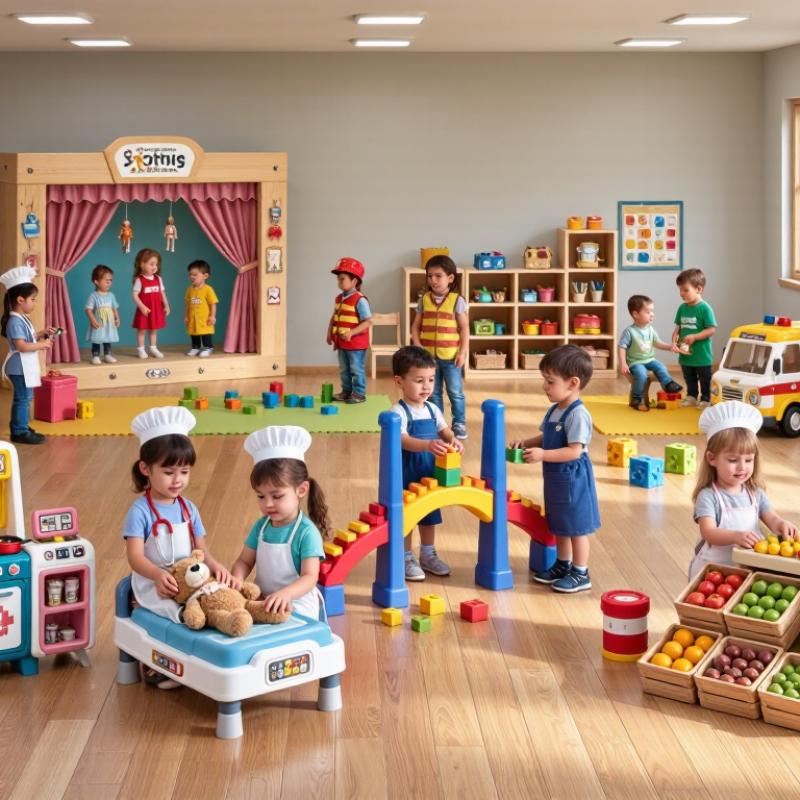
Definition and Criteria for Teamwork-Focused Pretend Play Toys
China Top 10 Pretend Play Toy Types That Foster Teamwork
Teamwork-focused pretend play toys let children share roles, negotiate rules, and complete one imagined task together. The toy is not defined by appearance alone. A miniature kitchen, rescue set, market stall, or construction scene qualifies only when several children can contribute meaningfully.
A practical evaluation uses four criteria: role flexibility, shared materials, communication demands, and a visible group goal. One child might prepare food, another serve it, while a third manages payment. No role should dominate every round. The set should also allow children to change roles without adult control. UNICEF’s Learning through Play report links play with cooperation, communication, and problem-solving. Meanwhile, a 2023 U.S. toy industry fact sheet recorded approximately 28.6 billion dollars in annual sales, showing the market’s scale but not automatically proving educational value. That distinction matters.
Tips:
Watch the first ten minutes. Do children ask each other questions, or simply grab pieces? Choose open-ended props, duplicate high-demand tools, and include visual role cards. Avoid sets with only one “leader” position. In real playrooms, conflict still happens. That is useful evidence, not failure. However, repeated exclusion may reveal poor design. My own assessment would also track turn-taking, repair after disagreement, and whether quieter children receive meaningful actions. A teamwork toy should create conversation, not just crowded play.
China’s Top 10 Pretend Play Toy Types for Cooperative Activities
China’s top 10 pretend play toy types support cooperative activities through shared roles and simple problems. They include kitchen sets, doctor kits, market stalls, construction tools, puppets, dress-up costumes, farm scenes, vehicle stations, family-care sets, and cooperative board games. Children can become cooks, patients, buyers, builders, drivers, or storytellers. These roles create natural reasons to speak, wait, exchange tools, and solve conflicts.
UNICEF’s 2018 Learning through Play report identifies social interaction as a core feature of effective play. The report also stresses active engagement, meaningful experiences, and repeated experimentation. In practice, a market game may require one child to price food, another to serve customers, and a third to manage pretend money. A 2022 global play survey covering more than 57,000 families also found strong parental support for play-based learning. Still, the evidence is not perfect. One confident child may control every role. The toy alone cannot guarantee teamwork.
Tips:
Choose open-ended sets with several equal parts. Give each child a clear role, then rotate roles after five minutes. Use small baskets, fabric food, clipboards, or cardboard tickets for realistic details. Adults should model phrases such as “Can we share?” and “What is your plan?” Avoid correcting every action. Children need room to negotiate, fail, and try again. A quieter child may need extra time, not extra pressure.
How Pretend Play Toys Develop Communication, Sharing, and Team Roles
China Top 10 Pretend Play Toy Types That Foster Teamwork
How Pretend Play Toys Develop Communication, Sharing, and Team Roles
Pretend play turns a small room into a restaurant, clinic, or construction site. China’s popular categories include kitchen sets, doctor kits, market stalls, costumes, puppets, dollhouses, vehicles, tool sets, building toys, and community-helper kits. Each type creates a shared problem. Children must explain ideas, listen, and decide who does what. A child serving pretend soup may ask for a plate. Another child becomes the customer. Simple dialogue begins teamwork.
The LEGO Foundation and UNICEF’s 2018 Learning through Play report identifies collaboration, communication, and problem-solving as core playful learning skills. A 2022 meta-analysis in Child Development Review examined 39 guided-play studies involving more than 3,800 children. It found positive effects on several learning outcomes, although pretend play alone does not guarantee cooperation. Adults should model useful phrases, such as “Can I join?” or “Let’s take turns.” Keep the support light. Too much direction can make play feel like a lesson.
In practice, role cards can help children share team responsibilities. One child plans the shop. Another counts objects. A third welcomes customers. Rotating roles prevents one confident child from controlling everything. Some children still argue over the stethoscope or the steering wheel. That conflict is not a failure. It reveals where communication needs practice. Durable, age-appropriate toys and open-ended pieces allow children to rebuild the story, change roles, and try a fairer solution.
Age, Safety, and Group-Play Factors for Selecting Suitable Toys
China’s top 10 pretend play toy types include kitchen sets, doctor kits, market stalls, construction sets, dress-up clothes, puppet theaters, rescue stations, farm sets, classroom sets, and post offices. Each type can support teamwork when children share roles, materials, and decisions. A market stall may need a seller, shopper, cashier, and stock manager. A puppet theater encourages children to plan scenes, speak clearly, and listen to different ideas.
Age suitability should guide every selection. Children under three need large pieces, rounded edges, and no detachable parts that fit inside a small-parts tester. For preschoolers, choose sturdy materials, washable surfaces, and simple role cards. Older children can handle smaller accessories, written signs, and more complex building tasks. Check hinges, seams, paint, and cords regularly. A loose button or cracked cup can quickly become a hazard. Safety guidance is not always obvious from attractive packaging.
Group size matters, too. Two children may manage one doctor kit, but six children need several roles and duplicate tools. Watch whether one child controls the whole story. That can happen even with a well-designed toy. Adults should model turn-taking without directing every action. In practice, some sets create cooperation, while others create arguments over one popular object. Adjustable roles, open-ended pieces, and clear storage can reduce that problem. Reflect after play, and change the setup when teamwork feels forced.
China Top 10 Pretend-Play Toy Types That Foster Teamwork
The chart rates each toy type from 1 to 5 for group-play potential, based on role variety, shared materials, communication, and turn-taking. For selection, match the toy with the child’s age label, check for small parts, and provide adult supervision when required.
Safety and age guidance: most pretend-play sets are commonly marked 3+, while sets containing miniature accessories may require closer supervision or an older age recommendation. Always follow the product’s applicable safety labeling.
How to Organize Pretend Play Sessions That Strengthen Teamwork
To strengthen teamwork, treat pretend play as a shared project, not a free-for-all. In a classroom or playroom, prepare ten role-play types: kitchen, clinic, shop, construction site, farm, transport station, rescue team, space crew, family home, and theater. Each setting needs three or more connected roles. Use simple props, picture cards, and a visible timer. Before play, ask children to choose roles together. Then give them a common mission, such as preparing a meal for six guests or repairing a cardboard station. Keep instructions brief. Children should negotiate most details themselves. I usually observe for five minutes before intervening. This reveals who leads, who waits, and who gets overlooked.
During the session, rotate roles every ten minutes. A child playing the customer can become the shopkeeper next. Offer phrases such as, “Can we plan this together?” and “What do you need?” These prompts support respectful communication without controlling the story. Check that props are safe, clean, and suitable for the children’s ages. Avoid assigning roles by gender or confidence. A quieter child may manage the map or record supplies. That role still matters. If conflict appears, pause the action and let children suggest two solutions. I once provided too many props, and the group argued over ownership instead of building a scene. Less equipment worked better. Afterward, ask what helped the team and what felt unfair. Their answers can improve the next session more than an adult’s perfect plan.
FAQS
It should support flexible roles, shared materials, communication, and a visible group goal. Several children need meaningful actions. Appearance alone is not enough.
Useful types include kitchen sets, doctor kits, market stalls, costumes, puppets, dollhouses, vehicles, tool sets, building toys, and community-helper kits. Each type offers shared problems to solve. Children can cook, treat, sell, build, drive, or tell stories together.
Children explain ideas, ask for materials, listen, and decide roles. A child serving pretend soup may request a plate. Another child can act as the customer. Simple dialogue becomes teamwork.
Give children clear, balanced roles and rotate them regularly. One child might plan the shop. Another counts objects. A third welcomes customers. No single role should control every round.
Add small baskets, fabric food, clipboards, cardboard tickets, or simple role cards. These objects create practical tasks. Children have more reasons to speak and exchange materials.
Adults can model phrases like “Can we share?” or “What is your plan?” They should avoid correcting every action. Conflict is useful. It shows where communication needs practice.
Watch the first ten minutes. Do children ask questions, share pieces, and repair disagreements? Check whether quieter children receive meaningful actions. Repeated exclusion may reveal weak design.
No. The toy alone cannot guarantee teamwork. A confident child may control every role. The evidence is also imperfect. Open-ended pieces help, but children still need time to negotiate, fail, and try again.
Conclusion
This guide explores China’s top 10 types of pretend play toys designed to encourage teamwork, including role-play kitchens, doctor sets, construction scenes, market stalls, rescue scenarios, transportation playsets, animal-care kits, community service sets, theater props, and creative building materials. It explains how to evaluate these toys by their ability to support shared goals, flexible roles, communication, turn-taking, and imaginative problem-solving rather than solitary play. The central question is: how do pretend play toys foster teamwork and cooperation? By giving children opportunities to negotiate roles, exchange ideas, share materials, and complete stories or challenges together.
The article also discusses how these activities develop listening, empathy, responsibility, and conflict-resolution skills. Parents and educators will find practical guidance on choosing age-appropriate, durable, and safe toys, considering group size, developmental levels, supervision, and accessible designs. Finally, it offers suggestions for organizing pretend play sessions with clear themes, rotating responsibilities, cooperative objectives, and time for reflection, helping children transform imaginative play into meaningful teamwork practice.

 Angeles Toys
