Pretend play turns ordinary objects into open-ended possibilities. A cardboard box becomes a shop; wooden blocks become a crowded city. In these small scenes, children invent characters, negotiate rules, and test what might happen next. That is why parents and educators often ask: how does pretend play encourage creativity?
The LEGO Foundation’s 2022 Play Well Study surveyed more than 55,000 parents and children across 30 countries. It found that 95% of parents viewed play as essential to children’s development. The finding reflects broad family perspectives, not proof that any single toy causes creative growth. Still, it supports a useful point: play deserves time and attention. Research guidance from the American Academy of Pediatrics also describes play as a way to support children’s cognitive, social, and emotional development.
A toy does not need a screen or a complicated design to spark an idea. A toy kitchen can invite a child to invent a menu, assign roles, and change the story when a “customer” asks for something unexpected. Open-ended toys may offer more room for these choices, but no toy guarantees imagination. Sometimes a child repeats the same game for days. That can be part of the process, too. This article explores how pretend play supports original thinking, problem-solving, and storytelling—and what adults can do to encourage it without taking over.
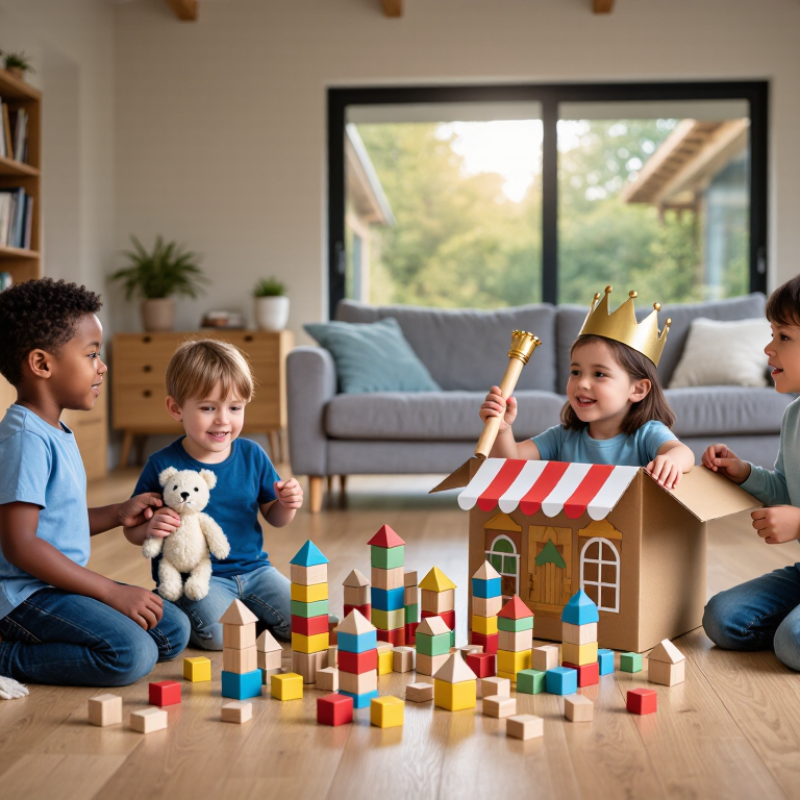
Pretend play happens when children use objects, roles, and imagined situations to make meaning. A wooden block can become a phone; a blanket may turn into a cave. The play has no fixed script. Children decide who is speaking, what a toy can do, and how a small problem might change.
Make-believe gives children a low-pressure place to practice language, social negotiation, and flexible thinking. A child running a pretend shop might count play coins, explain a price, then change the rules when a friend disagrees. These moments are not formal lessons, and every child plays differently.
Caregivers can notice how children plan, take turns, and express feelings. Figures, blocks, play food, or fabric can support many stories without prescribing one answer. A simple setup is enough. Adults can listen, offer a question, then leave room for the child’s ideas.
It is easy to over-direct. A neat story is not always the goal; pauses, repeated scenes, and odd plot twists may matter too. Children may also prefer playing alone, and that can be part of their own approach.
In pretend play, a cardboard box becomes a ferry, and a wooden spoon might be the captain’s microphone. Children invent roles, set rules, and revise the story when a passenger “misses” the boat. These small decisions exercise imagination and original thinking: a child must picture what is not there, then make the idea understandable to someone else. The UNICEF report Learning through Play (2018) describes effective playful learning as joyful, meaningful, actively engaging, iterative, and socially interactive. Role-play can bring all five qualities into one scene.
The OECD’s PISA 2022 creative-thinking assessment covered 64 countries and economies, treating creative thinking as a skill that can be assessed. That finding does not prove pretend play causes creativity. A review in Psychological Bulletin by Lillard and colleagues (2013) also cautioned that strong causal evidence for pretend play’s developmental benefits is limited. That caveat matters. Play is valuable, but it is not a guaranteed creativity machine.
Adults can help by offering open-ended materials: fabric scraps, paper maps, empty boxes, and safe household objects. Ask, “What happens next?” then leave space for the child’s answer. Resist correcting every unlikely detail. Sometimes a chair becomes a submarine, and the story makes little sense to us. That is part of the work. Over-directing can quietly replace a child’s idea with an adult’s.
A pretend-play toy should leave room for a child’s own plot. Open-ended pieces—cloth, cardboard food, wooden figures, or a plain playhouse—can become a shop, clinic, or spaceship. Reusable parts invite children to change roles and solve small story problems. UNICEF’s 2018 Learning through Play report describes playful learning as joyful, active, meaningful, iterative, and social. These qualities point to useful design choices: movable parts, simple props, and space for children to play together. Small details matter. A flap that opens or a cup that fits a toy hand can spark a new scene.
Toys also benefit from being sturdy, easy to handle, and flexible across ages. A short costume cape may become a blanket; a set of blank cards can turn into menus or maps. Avoid relying on fixed sounds or scripted phrases. They can entertain, but may leave less room for children to invent dialogue. The 2017 Lancet analysis estimated that 250 million children under five in low- and middle-income countries risked not reaching their developmental potential. That figure is not a measure of toy effectiveness, but it underscores why supportive early experiences matter. No toy guarantees creativity. Adults can watch, listen, and offer one open question—“What happens next?”—then let the child lead.
A child’s story often begins with one small object: a scarf becomes a river, and a wooden block becomes a boat. As children assign roles and invent problems, they practise sequencing, vocabulary, and perspective-taking. A caregiver can gently extend the plot with questions such as, “What does the captain hear?” Then wait. The pause gives the child room to decide what happens next.
UNICEF’s 2019 A World Ready to Learn report estimated that 175 million children were not enrolled in pre-primary education worldwide. That figure does not measure pretend play, but it highlights why accessible storytelling at home and in community settings matters. A cardboard box and a few safe household objects can invite rich play without elaborate materials. The American Academy of Pediatrics’ 2018 clinical report, The Power of Play, describes play as a way to support language, social skills, and self-regulation. Still, adults can over-direct. I sometimes catch myself trying to make a story “make sense” too soon. Children’s plots can be wonderfully messy. Let the dragon lose its map, change its mind, or ask for a snack. That detour may be where the child’s own idea takes shape.
Choosing China best toys to support creative play starts with the child, not the packaging. Look for open-ended pieces that can become many things: wooden blocks for a bridge, fabric scraps for a cape, or simple figures for a made-up village. A toy with one fixed function may entertain briefly; flexible materials invite children to change the story. Keep the child’s age and abilities in mind, especially when a set includes small parts.
Watch how the toy feels in everyday use. Are edges smooth? Do pieces fit together without constant adult help? Ask suppliers for clear material information, age guidance, and relevant safety test documents. These details matter more than bright photos. A large box of accessories can look generous, yet overwhelm a young child. Sometimes fewer pieces work better.
Notice what happens after the first few minutes. Does a child combine the toy with household objects, invent roles, or solve a small problem? Those are useful signs of engaged play, though no toy guarantees creativity. A cardboard box may win the afternoon. Adults can support play by asking, “What could this become?” Then wait. The answer may be surprising, or the child may simply want to build the same tower again.
| Pretend-Play Dimension | Example Play Scenario | Creative Skills Practised | How to Support the Play | What You May Observe |
|---|---|---|---|---|
| Symbolic thinking | A child uses a block as a phone or a cardboard box as a bus. | Representing one object with another and imagining new possibilities. | Offer open-ended props such as blocks, fabric, boxes, and toy dishes without prescribing how to use them. | The child gives familiar objects new roles and explains what they represent. |
| Story building | Figures go on a trip, meet a problem, and decide how to get home. | Creating characters, settings, events, and simple story sequences. | Ask open questions such as, “What might happen next?” and let the child lead the story. | The child adds events or details and changes the story as play develops. |
| Flexible problem-solving | A pretend shop runs out of bags, so players find another way to carry their items. | Trying alternatives, adapting ideas, and making decisions within an imagined situation. | Provide versatile materials and allow time for children to work through play problems themselves. | The child suggests or tests different solutions rather than relying on a single fixed plan. |
| Role-taking and perspective | Children take turns being a customer, shopkeeper, patient, or caregiver. | Exploring different viewpoints and using language suited to a role. | Provide simple role-play props and join only when invited, following the children’s ideas. | The child changes actions or dialogue to fit the character or situation. |
| Collaborative imagination | Players build an imaginary campsite together and decide what happens there. | Sharing ideas, negotiating roles, and combining different contributions. | Choose durable, easy-to-share materials and encourage turn-taking without directing the storyline. | Players respond to one another’s ideas and develop a shared play theme. |
Choose open-ended pieces, such as wooden figures, cloth, or a plain playhouse. They can become many things.
A scarf can become a river, and a block can become a boat. Small props can lead to surprising plots.
Ask one open question, such as, “What happens next?” Then wait.
Gentle questions can extend a plot, but too much direction may limit the child’s ideas. I sometimes try to make the story make sense too soon.
Inventing roles and problems can help children practise vocabulary, sequencing, perspective-taking, and social skills.
Consider the child’s age and abilities. Check for smooth edges, easy-to-handle pieces, and clear material and safety information.
Not necessarily. A large set may overwhelm a young child; a few blocks or blank cards may be enough.
Notice whether the child invents roles, combines pieces with household objects, or solves small problems. No toy guarantees creativity.
No. A cardboard box and a few safe household objects can inspire play. Sometimes, the box wins the afternoon.
Pretend play allows children to explore everyday experiences, invent new situations, and express ideas through make-believe. When they take on different roles, they imagine how others might think and act, creating opportunities to practice empathy, flexible thinking, and original problem-solving. This is one way to understand how does pretend play encourage creativity: children are free to transform familiar objects, change the direction of a story, and discover their own solutions without needing a single “right” answer.
Toys with adaptable shapes, open-ended uses, and simple details can inspire children to create characters and settings rather than follow fixed instructions. As children build stories through play, they develop plots, describe events, and respond to unexpected ideas from playmates. Choosing China best toys for creative play means looking for safe, age-appropriate options that invite exploration and can be used in many different ways. These playful experiences can support imagination, communication, and confidence as children learn to bring their ideas to life.

Angeles Toys