7 Best Pretend Play Toys That Support Child Development

Time:2026-11-07 Author:Mason
0%

How do pretend play toys support child development? A toy stethoscope, a wooden cash register, or a cloth food basket can turn an ordinary room into a clinic, shop, or kitchen. In these imagined settings, children practise language, cooperation, and flexible thinking while making up roles and solving small problems. The American Academy of Pediatrics’ 2018 clinical report, “The Power of Play,” describes play as supporting children’s cognitive, physical, social, and emotional development. Developmental psychologist Kathy Hirsh-Pasek captures its importance: “Play is not a luxury. Play is a necessity.” Simple props can open the door. The child supplies the story.

The benefits are not automatic, though. A toy cannot guarantee learning, and children do not need elaborate sets to invent meaningful play. A 2013 review in Psychological Bulletin by Angeline Lillard and colleagues cautioned that evidence for pretend play causing many specific developmental gains remains limited. That nuance matters. Adults can offer safe, open-ended toys, follow a child’s lead, and join in without taking over. A pretend grocery game might involve sorting bright felt fruit, counting coins, and negotiating who serves next. These moments can invite practice, but each child’s play unfolds differently. The seven toys in this guide are selected for opportunities they create—not promises they make. Good play can be noisy. It can also be a little uneven.
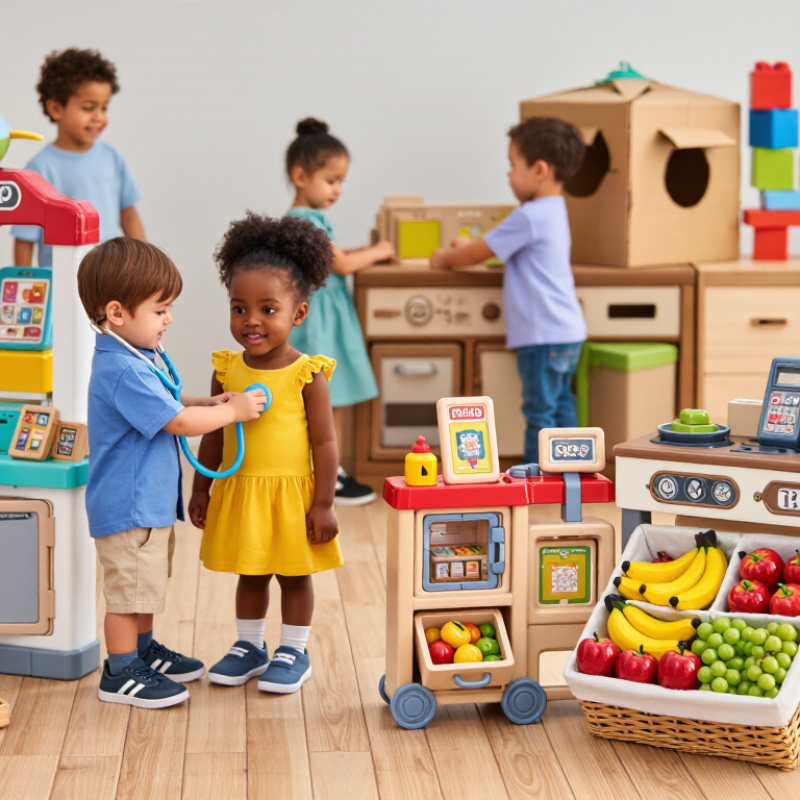
7 Best Pretend Play Toys That Support Child Development

Define Pretend Play: CDC Lists Pretend Feeding as a 30-Month Milestone

At 30 months, pretend play can look wonderfully ordinary: a toddler lifts an empty spoon to a teddy bear’s mouth, wipes its face, then offers another bite. The CDC lists pretending to feed a doll or stuffed animal as a developmental milestone at this age. This small scene reflects imitation and emerging symbolic thinking. The spoon stands in for food, and the toy becomes a hungry companion. Play may be brief or wonderfully repetitive.

A milestone is a helpful observation, not a diagnosis or a deadline. CDC milestones describe skills most children, about 75% or more, can do by a given age. Children develop at different rates, so one missed pretend-feeding moment does not tell the whole story. Watch for patterns across daily play and communication. If concerns persist, discuss them with a child’s healthcare professional. Simple toys can invite this play: a soft doll, a toy cup, or a clean plastic spoon. Adult attention matters more than a crowded playroom.

Tips: Offer a spoon and toy meal, then let your child lead. Name the actions gently: “Teddy is hungry.” Avoid correcting every detail. Sometimes the pretend soup is served upside down.

Map Developmental Benefits: Language, Social Skills, and Problem-Solving

Pretend play gives children a reason to talk, listen, and test ideas. A play kitchen can spark requests for a wooden spoon or a pretend meal. A market stall adds counting, turn-taking, and questions such as, “What would you like?” A doctor kit can help children practice describing a problem and listening to another person. Dolls and animal figures invite storytelling, including feelings and conversations. Small details matter.

Other useful choices include costumes, toy tools, and building blocks. Costumes let children try out roles and negotiate who plays each character. With toy tools, they can plan a simple repair, notice when a piece does not fit, and try another approach. Blocks encourage spatial reasoning: a tower tips, so the builder changes its base. These moments support problem-solving without requiring an adult to supply every answer. Let the play breathe.

Caregivers can extend the language by asking open questions, then waiting for a reply. “What happens next?” often works better than correcting a child’s story. Play does not guarantee a particular skill, and some days a child may prefer to repeat one scene. That is useful to notice, too. Offer a few safe, age-appropriate props, follow the child’s interests, and allow roles to change. Forcing a lesson can make play feel like work.

Compare 7 Toy Types: Kitchens, Dolls, Doctor Kits, Dress-Up, and More

Pretend play toys give children a low-pressure way to explore everyday roles and ideas. A toy kitchen can prompt planning, turn-taking, and talk about ingredients. Dolls invite caregiving stories, while doctor kits let children practice naming feelings and body parts through gentle pretend checkups. Dress-up clothes can help a child try out different roles. Simple props work, too.

A pretend shop adds counting and polite conversation; blocks can become a clinic, a bus, or something else entirely. Puppets encourage storytelling and listening. No toy guarantees a particular skill, and some children may ignore a carefully chosen set. That is normal. Follow the child’s lead instead of correcting every detail.

Tips: Choose sturdy, age-appropriate pieces, and check small parts for younger children. Offer a few props at a time, such as a cloth, a box, and toy food. Ask open questions: “What happens next?” Then wait. Children may change the story halfway through, and that can be part of the learning. Parents can join briefly, but leave room for the child to direct the play.

7 Pretend Play Toy Types and the Skills They Can Encourage

Ratings show illustrative opportunities for practicing each skill, on a 0–5 scale; they are not clinical assessments or experimental outcome data. The skills children practice depend on how they play and on adult interaction.

Match Toys to Age and Safety: CPSC Bans Small Parts for Children Under 3

Pretend play can build language, turn-taking, and flexible thinking, but the right toy depends on a child’s age and abilities. In the United States, CPSC rules prohibit toys intended for children under three from containing small parts that fit the agency’s small-parts test cylinder. Check age guidance and warnings before buying, then inspect playsets for loose buttons, tiny pretend food, or detachable accessories. A label is useful, but it cannot replace an adult’s judgment.

Small parts matter. CPSC estimated 231,700 toy-related emergency department visits among children aged 14 and younger in 2023, according to its Toy-Related Deaths and Injuries report. That figure covers many toy hazards, not only choking, so it should not be read as a small-parts count. Choose sturdy kitchen sets, large play tools, or dress-up items with securely attached pieces for younger children. For children under three, keep small accessories out of reach, even when an older sibling’s toy is nearby. The age boundary can feel overly cautious during ordinary play; still, a quick floor check after play can catch pieces adults missed.

Choose Open-Ended Play: AAP on Play’s Role in Healthy Development

Open-ended pretend play lets children turn simple objects into changing stories. A cardboard box can become a bus, a shop, or a quiet hiding place. The American Academy of Pediatrics (AAP) recognizes play as an important part of healthy development. Through make-believe, children practice language, cooperation, and flexible thinking. A stuffed animal may need a checkup; a toy cup may become dinner for a whole family. The child decides what happens next. That choice matters.

Useful pretend-play toys do not need many features. A few figures, play food, blocks, or fabric pieces can support many different stories. Let them lead. Adults can join by asking, “What should happen now?” rather than correcting every detail. It is easy to turn play into a lesson, though; sometimes children just want to repeat the same scene. That can feel dull, but repetition may help them explore an idea at their own pace. Keep small parts away from children who might mouth them, and choose materials suited to their age. A little mess is normal. So is a story that makes no sense to grown-ups.

7 Best Pretend Play Toys That Support Child Development — Choose Open-Ended Play: AAP on Play’s Role in Healthy Development
Pretend-Play Toy Ways It Can Support Development Open-Ended Play Possibilities Helpful Adult Support
Dolls, Stuffed Animals, or Simple Figures Encourages storytelling, conversation, caring routines, and exploration of feelings and relationships. Children can invent characters and stories, act out everyday events, or create entirely imaginary worlds. Join the story when invited, model kind language, and let the child decide what happens next.
Play Kitchen and Food Offers opportunities to practice language, sequencing, cooperation, and familiar daily-life routines. A few safe, simple props can become a restaurant, picnic, grocery stand, or imaginary meal. Ask open questions such as “What are you making?” Avoid turning play into a test or lesson.
Dress-Up Clothes and Accessories Supports self-expression, imagination, role-play, and conversation about different people and situations. Everyday scarves, fabric, and simple clothing can become costumes for changing stories and roles. Offer comfortable, age-appropriate items and check that accessories do not create choking or strangulation hazards.
Toy Medical Kit Can help children act out caregiving, communicate about experiences, and explore feelings around everyday checkups. A doll, stuffed animal, or family member can become a patient in a clinic, rescue, or home-care story. Follow the child’s lead and use calm, reassuring language; pretend play is not a substitute for medical advice.
Blocks and Building Pieces Combines imaginative scenarios with practice in planning, problem-solving, spatial reasoning, and fine-motor coordination. Buildings can become homes, shops, castles, or settings for figures and invented stories. Let children experiment with their own designs and choose pieces that are safe for their age and mouthing habits.
Animal or Community-Helper Figures Can prompt storytelling, vocabulary, perspective-taking, and exploration of community roles or animal habitats. Figures can be used in rescue missions, family stories, journeys, or made-up settings. Invite the child to describe characters’ ideas and feelings without prescribing a single “right” story.
Toy Cash Register or Market Props Encourages social interaction, turn-taking, everyday vocabulary, and playful exposure to counting and sorting. Children can create a market, café, ticket booth, or another familiar community setting. Keep the activity playful and child-led; use large, safe props and supervise small pieces.

Play-first reminder: The American Academy of Pediatrics describes play as important to healthy development, including learning, relationships, and well-being. These toys offer opportunities for development, but no toy guarantees a particular outcome. Choose age-appropriate, safe materials, and allow time for child-led play.

FAQS

What does pretend feeding look like around 30 months?

A toddler may lift an empty spoon to a teddy bear, wipe its face, and offer another bite. The play may be brief or repetitive.

What can pretend feeding show?

It can reflect imitation and emerging symbolic thinking. The spoon stands in for food, and the toy becomes a hungry companion.

Does one missed pretend-play moment mean a child is behind?

No. A milestone is an observation, not a diagnosis or deadline. Look for patterns across play and communication.

When should I discuss a concern with a professional?

If concerns persist, talk with your child’s healthcare professional. One quiet afternoon is not the whole picture.

What simple items can encourage pretend play?

Try a soft doll, toy cup, clean spoon, cloth, or box. A crowded playroom is not needed.

How can I join without taking over?

Offer a toy meal and let your child lead. You might say, “Teddy is hungry,” then wait. Upside-down soup is fine.

What kinds of toys can support pretend stories?

Toy kitchens, dolls, doctor kits, dress-up clothes, puppets, blocks, and pretend shops can spark different roles and ideas. No toy guarantees a skill.

What if my child ignores a toy or changes the story?

That is normal. Follow their lead and ask, “What happens next?” Adults can overthink it.

Conclusion

Pretend play turns everyday objects and familiar roles into opportunities for children to explore ideas and practice new skills. The CDC lists pretend feeding, such as giving a doll a drink, as a developmental milestone around 30 months. These playful moments can encourage language as children describe what they are doing, build social skills as they take turns or act out relationships, and strengthen problem-solving as they invent stories and find ways to keep them going. Understanding how do pretend play toys support child development starts with seeing them as tools for imagination, communication, and practice.

Seven useful toy types include play kitchens and food, dolls and animal figures, doctor kits, dress-up clothes, toy vehicles, building sets, and pretend shops or tools. Choose options that suit a child’s age, interests, and abilities, and check for small parts: CPSC guidance prohibits small parts in toys intended for children under three. Simple, open-ended toys can be used in many different ways, letting children lead the play. The AAP recognizes play as an important part of healthy development, so the best choice is often one that invites children to imagine, create, and play together.

Mason

Mason

Mason is a seasoned marketing professional with a deep expertise in the company's offerings and a passion for driving brand awareness. With a strong background in digital marketing strategies, he has an innate ability to connect with diverse audiences and effectively communicate product benefits.......