2026 Best Pretend Play Toys for Real Life Skills?

Time:2026-10-10 Author:Henry
0%

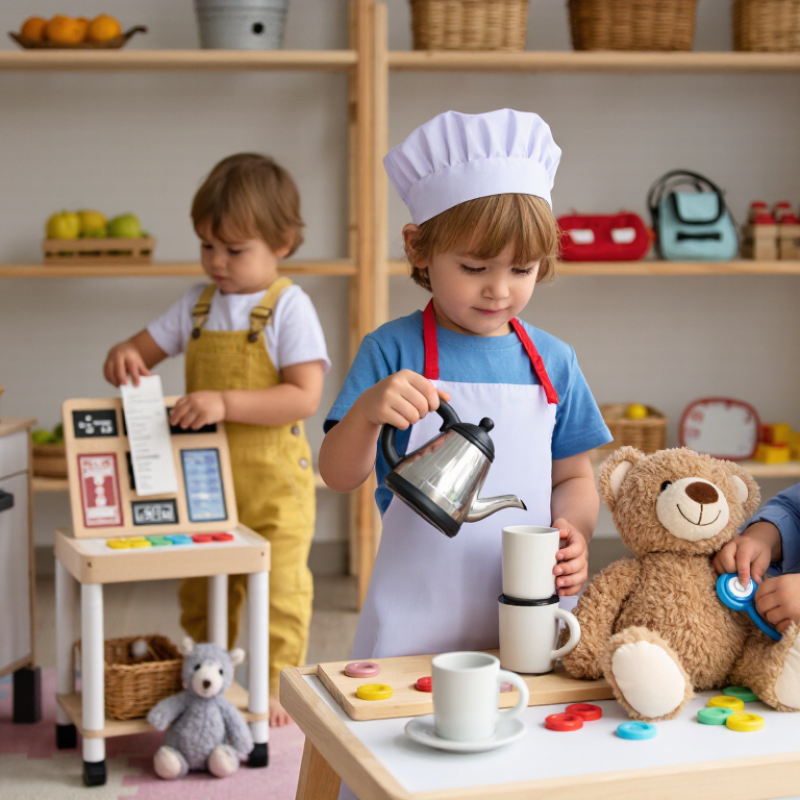
Pretend play is more than a cheerful break from structured learning. A toy kitchen, doctor kit, or cash register can turn an ordinary room into a small world of meaningful decisions. Children pour pretend tea, comfort a stuffed patient, count plastic coins, and negotiate who will serve dinner. These actions make unfamiliar adult routines easier to explore.

So, how do pretend play toys help children understand real life situations? They give children a safe space to rehearse communication, problem-solving, empathy, and responsibility. A child may practice saying, “Please wait,” while playing shop. Another may learn that a nurse listens before offering help. The objects provide concrete prompts, but the child creates the story.

Child-development researcher Dr. Peter Gray writes, “Play is nature’s way of ensuring that young mammals acquire the skills necessary to survive and thrive.” His view highlights play as active learning, not simple entertainment. Still, a toy does not automatically build life skills. Adult guidance, open-ended use, and repeated practice matter. Too many instructions can quietly remove the child’s ownership of the story.

The 2026 guide to the best pretend play toys for real-life skills will examine what children actually do with each toy. It will consider realistic details, emotional growth, cooperation, and everyday independence. Some choices may look impressive but offer little flexibility. Others may appear simple, yet inspire rich conversations. That difference deserves attention.
2026 Best Pretend Play Toys for Real Life Skills?

Define Real-Life Skill Play Through Lillard et al.’s 2013 Evidence Review

2026 Best Pretend Play Toys for Real Life Skills?

Real-life skill play should mean more than colourful objects and scripted stories. Lillard et al.’s 2013 evidence review examined pretend play and child development. It found promising links, but limited proof that pretend play directly causes better thinking, language, or social outcomes. That distinction matters when choosing toys.

A useful pretend-play set mirrors ordinary routines. A small kitchen can support planning, turn-taking, and simple sequencing. Cloth, cups, notebooks, and safe containers can become a shop, clinic, or travel station. Children can practise asking questions, waiting, sorting, cleaning, and explaining choices. These actions resemble daily tasks more closely than pressing a button for a fixed response. Open-ended materials leave room for mistakes.

I have seen children ignore elaborate sets and repeatedly use a cardboard box. That observation challenges adult assumptions about “best” toys. Adults should watch the child’s actions, not judge the toy’s appearance. A child who pretends to prepare lunch may practise memory and cooperation, but the play does not automatically create those skills. Guidance, language, and repeated real experiences still matter. Evidence remains uneven. That is the honest part. A 2026 choice should therefore favour flexible, durable materials that invite conversation and adapt to a child’s interests, while avoiding promises that one toy can build real-life competence alone.

2026 Best Pretend Play Toys for Real-Life Skills?

Defining Real-Life Skill Play Through Lillard et al.’s 2013 Evidence Review

This chart uses a transparent evidence coding rather than effect sizes: 1 indicates that Lillard et al. reported mixed, correlational, or limited evidence for a developmental claim, while 0 indicates that the review did not establish a reliable causal benefit. Pretend play can still provide opportunities to rehearse communication, planning, cooperation, self-regulation, and problem-solving, but the review cautions against treating pretend play alone as proven to cause these outcomes.

Source: Lillard, A. S., et al. (2013), “The impact of pretend play on children’s development: A review of the evidence,” Psychological Bulletin.

Match 2026 Toys to CDC Age-4 Developmental Milestones

2026 Best Pretend Play Toys for Real Life Skills?

For age four, toy choice should follow development, not advertising. The CDC lists pretend play, cooperative play, four-word sentences, color naming, simple drawing, and large-ball catching as common milestones. Choose a small kitchen set, fabric costumes, animal figures, crayons, and a soft ball. These props encourage children to act out shopping, cooking, helping, and caring. The American Academy of Pediatrics links playful role-play with language, executive function, and social-emotional growth. However, one toy cannot create every skill.

The Toy Association’s 2024 U.S. Toy Industry Fact Sheet reported approximately 28.6 billion dollars in 2023 toy sales. That scale shows strong demand, but more products do not guarantee better learning. I sometimes overvalue realistic accessories. A cardboard box may produce richer storytelling than a crowded playset. I would watch how a child uses the toy: Do they invite another player? Can they explain a pretend problem? Can they draw a person afterward? A missed milestone is not automatically a toy problem. Discuss persistent concerns with a pediatric professional.

Tips: Keep four or five open-ended props accessible. Add a basket, cups, paper, and washable markers. Prompt gently: “Who needs help?” Then pause. Let the child lead. Rotate materials weekly, and avoid correcting every detail. Short play sessions work well. Stop when interest fades.

Apply ASTM F963-23 and CPSC Small-Parts Safety Standards

2026 Best Pretend Play Toys for Real Life Skills?

Apply ASTM F963-23 and CPSC Small-Parts Safety Standards

Pretend play can teach children to sort food, follow routines, and practice careful hand movements. A toy kitchen, doctor set, or repair kit should support these skills without creating hidden hazards. Under ASTM F963-23, manufacturers evaluate toys for mechanical, physical, chemical, electrical, and flammability risks. The standard also addresses accessible components that children may pull, twist, or break.

Small parts require special attention. CPSC rules generally prohibit small parts in toys intended for children under three. The test uses a small-parts cylinder, along with reasonable use and abuse testing. Loose beads, tiny handles, removable caps, and miniature tools may become choking hazards. A warning label cannot replace safe construction when the product targets younger children. Age grading must match the toy’s actual design.

A practical review should inspect seams, hinges, fasteners, and storage pieces. Try gentle pulling and repeated opening, but do not perform unsafe destructive tests around children. Check whether a plastic edge feels sharp after normal play. I have seen attractive play sets overlook one removable detail. That small oversight can change the safety assessment. Reliable suppliers should provide applicable test reports from qualified laboratories and supporting compliance records. Retailers should also verify the product’s age range, instructions, and warning language before listing it. Safety work is never perfectly finished. Designs improve when reviewers question their first impression.

2026 Best Pretend Play Toys for Real Life Skills? - Apply ASTM F963-23 and CPSC Small-Parts Safety Standards

Pretend-Play Toy Format Primary Real-Life Skills Typical Age Band* Common Small-Part Concern Safety Screening Priority Suggested Use
Pretend Kitchen Set Meal planning, sorting, turn-taking, vocabulary, basic food and household routines 2–6 years Miniature utensils, removable knobs, detachable food pieces, and loose fasteners Check detachable components, accessible edges, hinge points, magnets, and food-contact simulation materials Supervise under 3
Doctor or Caregiver Kit Empathy, communication, body-awareness language, sequencing, and cooperative play 3–6 years Small pretend tablets, syringe plungers, clips, caps, or removable accessories Assess small parts, pointed ends, pinch or crush points, cords, and whether accessories can be detached during foreseeable use Age-grade carefully
Pretend Grocery and Market Set Counting, categorization, decision-making, social exchange, and early money concepts 3–6 years Small coins, tokens, labels, clips, and individual food replicas For products intended for children under 3, verify that no component is a prohibited small part; evaluate packaging and loose accessories separately Use with supervision
Tool and Repair Workshop Problem-solving, hand strength, planning, tool recognition, and following simple procedures 3–7 years Nuts, bolts, washers, interchangeable bits, and small construction pieces Check choking hazards, torque-related breakage, sharp points, tool handles, and components that may become detached after repeated use Adult guidance advised
Cleaning and Household Routine Set Self-care routines, responsibility, sequencing, cooperation, and practical vocabulary 2–5 years Small caps, detachable handles, removable clothespins, and narrow accessory pieces Ensure the product cannot be confused with real cleaning chemicals; inspect closures, edges, handles, and detachable parts Prefer larger parts
Dress-Up and Community-Role Kit Communication, imagination, cultural awareness, confidence, and social role exploration 3–8 years Buttons, badges, jewelry-like pieces, detachable decorations, and long cords Evaluate entanglement, strangulation, sharp decorative elements, accessible fasteners, and flammability requirements where applicable Supervise costume play
Pretend Office or School Set Writing readiness, organization, listening, planning, and cooperative communication 3–7 years Small stamps, clips, erasers, removable pen parts, and miniature stationery Check point and projection hazards, breakage under foreseeable abuse, ink or material safety, and small parts access Choose oversized pieces
Home-Building and Family-Routine Set Planning, emotional expression, negotiation, household awareness, and narrative development 3–8 years Small furniture accessories, miniature dishes, removable doors, and tiny figures Test structural stability, tip-over resistance, accessible small parts, magnets, sharp edges, and repeated-use durability Best with shared play
2026 Safety and Compliance Reference
• ASTM F963-23 is the current ASTM toy-safety revision referenced by the U.S. mandatory toy-safety rule in 16 CFR Part 1250. Applicable provisions may include mechanical and physical properties, flammability, electrical safety, labeling, and material-specific requirements.
• CPSC small-parts requirements are established in 16 CFR Part 1501. A small part is generally evaluated using the regulatory small-parts cylinder; toys intended for children under 3 years must not contain prohibited small parts.
• Age grading must reflect the toy’s design, marketing, and reasonably foreseeable use. An age label alone does not remove applicable safety obligations.
• This comparison is a product-screening guide, not a certification. Manufacturers, importers, and private-label suppliers should obtain required testing, tracking labels, certificates, warnings, and applicable CPSC compliance documentation before sale.
*Typical age bands are educational play-use ranges and may vary according to the toy’s size, complexity, components, and intended use.

Compare Home, Store, Medical, and Community Role-Play Kits

2026 Best Pretend Play Toys for Real Life Skills?

Home role-play kits turn ordinary routines into practice. Children can sort play food, set a table, fold fabric, or organize a small kitchen. These tasks build sequencing, vocabulary, fine motor control, and cooperation. In home play sessions, I have noticed children explain chores more clearly after repeated pretend practice. The play still needs room for mistakes.

Store kits add social and early math skills. A small counter, reusable tokens, baskets, and picture labels create realistic exchanges. Children can compare sizes, count items, greet customers, and solve simple problems. Adults should model fair turn-taking instead of controlling every scene. Too much instruction can make play feel like a worksheet.

Medical kits support caring language and body awareness when used gently. Toy thermometers, bandages, and clipboards can introduce words such as comfort, check, and rest. Choose rounded tools and washable materials, and avoid frightening procedures. Community kits extend play beyond the home. A post office, transit station, library, or rescue center encourages mapping, teamwork, and public manners. I sometimes find community scenes harder to guide because children invent unexpected rules. That is useful, but adults should correct unsafe behavior and explain real-world boundaries. A pretend appointment is not medical advice. A play purchase is not a real transaction. Each kit works best when children can change roles, pause, and try again.

Assess STEM and Money Play Using OECD Learning-Skills Frameworks

2026 Best Pretend Play Toys for Real Life Skills?

Assess STEM and Money Play Using OECD Learning-Skills Frameworks

Pretend play becomes more valuable when children make decisions, not just press buttons. The OECD Learning Compass 2030 emphasizes student agency, collaboration, knowledge, skills, attitudes, and values. A strong STEM play set might include measuring cups, ramps, gears, or reusable building pieces. Children can predict, test, fail, and revise. Those small failures matter. The World Economic Forum’s Future of Jobs Report 2025 identifies analytical thinking as a leading workplace skill. It also estimates that 39% of workers’ core skills may change by 2030. Play should therefore reward questions, not perfect results.

Money play needs equal care. A pretend shop can introduce prices, counting, comparison, saving, and delayed choices. Add paper receipts, a small budget, and limited tokens. Ask, “Can we afford both?” OECD PISA 2022 financial-literacy findings show that roughly one in five students in participating systems did not reach baseline proficiency. That gap makes everyday practice useful, but a toy cash register alone is insufficient. Children need conversation, mistakes, and changing scenarios. A “sale” can teach arithmetic, yet it may also confuse value with constant buying.

My practical assessment is imperfect. I look for open-ended materials, visible quantities, and shared problem-solving. I also watch whether adults allow children to lead. A child who redesigns a bridge or postpones a purchase is practicing agency. The lesson may be messy. That is often the point.

FAQS

What makes a pretend-play toy useful for real-life skills?

It should mirror ordinary routines, such as cooking, shopping, cleaning, or planning a trip. Children can sort items, ask questions, wait, and explain choices. Open-ended materials usually offer more practice than fixed button responses.

Can one toy automatically build thinking or social skills?

No. Research suggests promising links, but it does not prove direct cause and effect. A pretend lunch may involve memory and cooperation, yet guidance and real experiences still matter. The toy alone is not enough.

Why are simple materials sometimes better than elaborate playsets?

A cardboard box can become a shop, bed, vehicle, or travel station. Cloth, cups, notebooks, and safe containers invite changing stories. Children may ignore expensive-looking sets. Adults should watch actions, not appearance.

How can adults support pretend play without controlling it?

Let children lead the scenario and make decisions. Ask, “What should we do next?” or “Can we solve this another way?” Offer language and gentle prompts. Too much adult direction can make play feel scripted.

What safety details should caregivers check?

Inspect seams, hinges, fasteners, storage pieces, and removable caps. Look for sharp edges after normal use. Pull gently on accessible parts. Small beads, handles, and miniature tools can create choking risks for young children.

Are warning labels enough for toys with small parts?

No. A warning cannot replace safe construction for younger children. Age guidance must match the toy’s actual design. Check whether parts can break loose during repeated opening, twisting, or ordinary handling.

How can STEM pretend play encourage useful thinking?

Provide ramps, measuring cups, gears, or reusable building pieces. Ask children to predict, test, fail, and revise. A bridge that collapses can become a useful lesson. Perfect results are not required.

How can money play teach more than buying?

Use paper receipts, visible prices, limited tokens, and a small budget. Ask, “Can we afford both?” Children can practise counting, comparing, saving, and waiting. A constant sale may confuse price with value.

What should adults remember when choosing a 2026 pretend-play toy?

Choose flexible, durable materials that invite conversation and adapt to changing interests. Observe whether children return to the toy voluntarily. My assessment may be imperfect. A modest box can outperform a crowded set.

Conclusion

This guide examines how pretend play toys help children understand real life situations by turning everyday experiences into safe, meaningful practice. Drawing on Lillard et al.’s 2013 evidence review, it explains how role-play can support language, social interaction, planning, problem-solving, and self-regulation. The guide also connects suitable 2026 toy features with CDC developmental milestones for four-year-olds, helping caregivers choose activities that encourage realistic but age-appropriate learning.

It compares home, store, medical, and community role-play kits, while considering how STEM tasks and money-based play can build early reasoning, numeracy, cooperation, and decision-making skills through an OECD-informed learning framework. Safety remains central: toys should be evaluated against ASTM F963-23 requirements and CPSC small-parts guidance, with close attention to age labeling, durable construction, and supervision. Overall, the best pretend play experiences combine imaginative freedom with practical challenges that help children explore responsibilities, relationships, and everyday choices.

Henry

Henry

Henry is a dedicated marketing professional with a profound expertise in the company's offerings. With years of experience in the industry, he possesses an impressive understanding of the market dynamics and consumer behaviors that drive success. Henry is committed to sharing his insights through......